

IPTV Every Month Subscribe: How Monthly IPTV Plans Work
Last updated: September 2026 · Reading time: 24 min · Expert level: Beginner to Advanced
- What an IPTV every month subscribe plan actually means — and how it differs from recurring auto-billing.
- How to subscribe to IPTV monthly, step by step, from choosing a provider to testing before renewal.
- How much an IPTV subscription costs per month and what drives the price up or down.
- Monthly plans vs 3-month, 6-month, and 12-month plans — the flexibility vs cost trade-off.
- Renewal mechanics, common problems, and how to troubleshoot them.
- How resellers automate monthly subscription workflows with AutoTaskClick's automation platform.
When someone searches for IPTV every month subscribe, they are usually looking for one of two things: a monthly IPTV subscription they can purchase and renew one month at a time, or a service where they subscribe to IPTV monthly without committing to a long-term contract. Both are valid interpretations, and both point to the same underlying need — flexibility and control over how long they pay for the service.
This guide answers the query directly, then walks through everything a monthly IPTV subscriber needs to know: how monthly plans work, what they cost, how renewals function, what to check before choosing a provider, and what to do when problems arise. It also covers the business side — how resellers manage the operational load that monthly subscribers create, and how automation changes that workflow.
📑 Table of Contents
- 1. What Is a Monthly IPTV Subscription?
- 2. How to Subscribe to IPTV Every Month
- 3. How Much Does IPTV Cost Per Month?
- 4. Monthly IPTV vs 3, 6, and 12-Month Plans
- 5. What Does IPTV Monthly Renewal Mean?
- 6. IPTV Every Month Subscribe vs Automatic Renewal
- 7. What to Check Before Subscribing
- 8. How to Test an IPTV Service Before Committing
- 9. Common Problems With Monthly Subscriptions
- 10. IPTV Subscription Management for Resellers
- 11. How Automation Changes a Monthly Reseller Workflow
- 12. Monthly IPTV Subscription FAQ
1. What Is a Monthly IPTV Subscription?
A monthly IPTV subscription is a plan that gives you access to IPTV content for a defined period — typically 30 days — after which you either renew or let the subscription expire. It is the shortest standard billing cycle offered by most providers, and it exists to serve subscribers who value flexibility over long-term commitment.
The term monthly IPTV subscription describes the subscription model. The phrase IPTV every month subscribe describes the action of paying for that subscription on a recurring, month-by-month basis. They are closely related but not identical — one is a product, the other is a purchasing behavior.
How a Monthly IPTV Plan Works
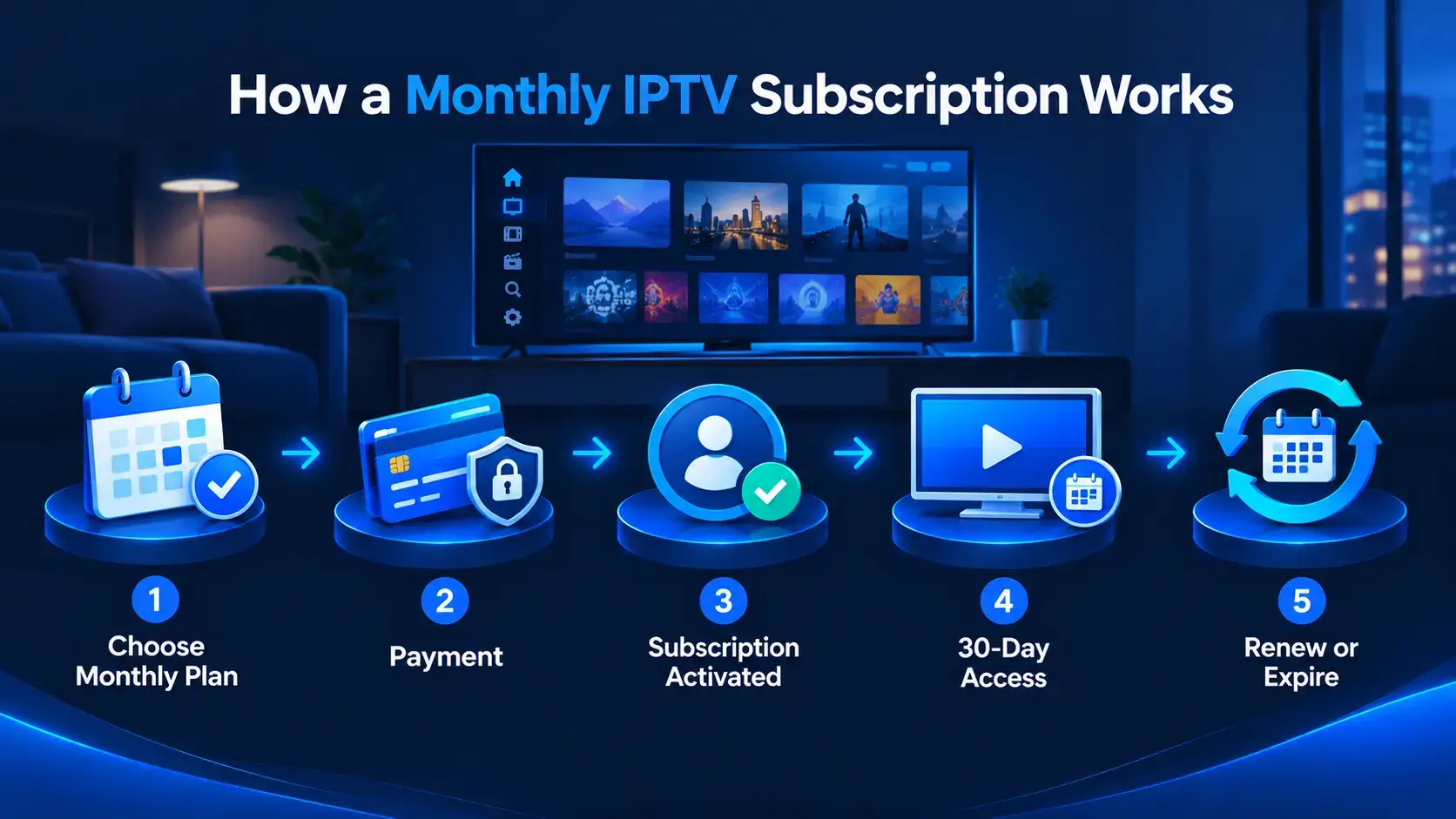
Most monthly IPTV plans follow the same six-step process:
- Choose a plan. You select a monthly subscription from the provider's offerings, usually with a defined number of simultaneous connections and a defined channel or VOD package.
- Complete payment. You pay for one month of access using the provider's accepted payment methods — which may include cards, PayPal, crypto, or other methods depending on the provider.
- Receive access credentials. After payment confirmation, the provider sends your credentials — typically a username, password, and server URL, an M3U playlist URL, or Xtream Codes API details.
- Configure a compatible application or device. You install an IPTV player on your preferred device and enter the credentials. Common players include IPTV Smarters, TiviMate, and VLC; common devices include Fire TV, Android TV, Smart TVs, and phones.
- Use the service during the subscription period. You watch channels and on-demand content through the player app until the subscription period ends.
- Renew when the period ends. Depending on the provider's terms, you either manually place a new order or the subscription renews automatically.
What Does "Every Month" Actually Mean?
The phrase "every month" can mean three different things, and providers rarely spell out the difference clearly. This is one of the most common sources of confusion for new subscribers.
- Manual monthly renewal. You purchase one month of access at a time. When the month ends, the subscription simply expires unless you place a new order. The provider does not charge you again.
- Automatic recurring billing. You authorize the provider to charge your payment method every month automatically. The subscription continues until you cancel it.
- Monthly access that simply expires. You buy one month, use it, and when the period ends, access stops. There is no auto-charge and no ongoing commitment.
The distinction matters because "monthly" does not automatically mean "auto-renewing." Some providers require you to renew manually every month. Others set up recurring billing. Before subscribing, confirm which model the provider uses.
Monthly IPTV vs Traditional TV Billing
Monthly IPTV plans and traditional cable or satellite subscriptions differ in several practical ways:
| Feature | Monthly IPTV | Traditional TV |
|---|---|---|
| Delivery | Internet connection | Cable or satellite |
| Billing | Monthly, or other terms depending on provider | Usually recurring monthly |
| Equipment | Depends on service — often your own device | Provider equipment often required |
| Flexibility | Depends on provider — monthly plans are typically the most flexible | Depends on contract length |
| Access device | Compatible devices you may already own | Provider-supported set-top box |
This comparison is factual rather than promotional. Whether IPTV is "better" than traditional TV depends on what you watch, where you live, what internet speed you have, and what content rights are legitimately available in your region.
2. How to Subscribe to IPTV Every Month
Subscribing to IPTV on a monthly basis is straightforward, but the steps matter — especially if you want to avoid problems later. Here is the complete process.
Step 1 — Find a Legitimate IPTV Service
The most important step. Before anything else, verify that the provider is authorized to distribute the content it offers in your region. IPTV is a technology — it is not inherently illegal. But a provider that streams copyrighted content without distribution rights is operating outside the law, regardless of how the technology works.
What to check at this stage:
- Does the provider clearly state its content licensing or distribution authorization?
- Does the provider have a real business presence — a physical address, a support system, published terms?
- Are there independent reviews or consumer reports you can verify?
- Does the provider appear in any consumer protection or scam warning databases?
Step 2 — Check the Monthly Plan
Once you have a shortlist of providers, review the monthly plan details carefully. The elements that matter most:
- Price. The total cost for one month of access, including any fees or taxes.
- Subscription duration. Confirm that the plan is 30 days (or the provider's defined month length).
- Number of connections. How many devices can stream at the same time using a single subscription.
- Supported devices. Which players and devices the service works with.
- Included features. Channel lineup, VOD, EPG, catch-up TV, and other features.
- Renewal conditions. Manual renewal, automatic renewal, or expiring access.
Step 3 — Check Compatibility
Before paying for a monthly plan, confirm that the service works with your device and your preferred player. Common combinations:
- Smart TVs. Some providers work directly with Smart TV IPTV apps; others do not.
- Android TV devices. Google TV, Nvidia Shield, and similar devices typically work well.
- Fire TV-type devices. Fire TV Stick and Fire TV Cube work with popular IPTV players.
- Phones and tablets. iOS and Android both have IPTV player apps that accept standard credentials.
- Computers. Desktop players such as VLC and IPTV Smarters work on Windows, macOS, and Linux.
Not every service works on every device. Check the provider's compatibility list before subscribing.
Step 4 — Complete Payment
Complete the payment through the provider's checkout process. Most providers accept a range of payment methods; some accept credit cards, PayPal, and cryptocurrency. After payment, you should receive a confirmation email that includes your order details and access instructions.
Step 5 — Set Up Your IPTV Access
Depending on the provider, you may receive some or all of the following:
- Username and password
- Server URL (also called the portal address)
- M3U playlist URL
- Xtream Codes API details
- EPG (electronic program guide) information
Enter the credentials into your chosen player app. Most players guide you through the setup process step by step.
Step 6 — Test Before Your Next Renewal
This step is often skipped, and it is where the most value lies. Before you commit to a second month, test the service thoroughly. Things to check:
- Channels you actually watch — not just the ones the provider advertises
- Peak-time performance during major events or evenings
- EPG accuracy and completeness
- VOD library if it matters to your usage
- Device compatibility during normal use
- Customer support responsiveness if you need to contact them
If the service performs well during the trial month, renewal is a reasonable decision. If it does not, you can walk away without a long-term commitment.
3. How Much Does IPTV Cost Per Month?
Monthly IPTV pricing varies widely depending on the provider, the content package, the number of connections, and the region. There is no single "correct" price, and any article that claims a universal number is oversimplifying.
What this section does instead is explain what drives the price — and how to evaluate whether a given price represents good value for what you actually receive.
What Determines the Monthly Price?
- Number of connections. A plan that allows two simultaneous streams typically costs more than a single-connection plan. Multi-device plans for households cost more still.
- Plan duration. Monthly plans generally cost more per month than longer plans. The longer the commitment, the lower the effective monthly cost — but with less flexibility.
- Content package. Larger channel lineups, premium sports, and extensive VOD libraries usually cost more than basic packages.
- Device support. Some providers charge more for plans that support multiple device types or advanced player features.
- Features. EPG, catch-up TV, and multi-language support may be included or priced separately.
- Customer support. Providers offering responsive, multi-channel support typically price their plans slightly higher.
- Service infrastructure. Providers with better server infrastructure, more geographic redundancy, and higher uptime tend to charge more.
Monthly Price vs Effective Monthly Cost
This is one of the most useful concepts for anyone comparing plans. The "monthly price" is what you pay for one month of access. The "effective monthly cost" is what you pay per month when you spread a longer plan's total cost across its duration.
Illustrative example — not market prices:
- 1-month plan. $15 for one month = $15 per month effective cost.
- 3-month plan. $36 total = $12 per month effective cost.
- 12-month plan. $96 total = $8 per month effective cost.
These numbers are illustrative only. Actual prices vary by provider and market. The point is that longer plans often lower the effective monthly cost — but you pay more upfront and lose the flexibility of monthly renewal.
Why Monthly Plans Often Cost More Per Month
Monthly plans carry what is sometimes called a "flexibility premium." You are paying more per month because you retain the option to cancel after 30 days without any further commitment. The provider takes on more administrative overhead per subscriber when renewal cycles are short, and that cost is reflected in the price.
For subscribers who value the ability to switch providers without penalty, the premium is often worth paying. For subscribers who have already settled on a provider they trust, a longer plan reduces cost per month.
Is the Cheapest IPTV Plan Always the Best Value?
No. Price is only one factor. When evaluating a cheap monthly plan, check:
- Reliability. A service that buffers every evening is not good value at any price.
- Support. If something goes wrong, can you reach anyone?
- Compatibility. Does it work with the devices you actually own?
- Transparency. Are the terms, renewal rules, and cancellation conditions clearly stated?
- Content authorization. Is the provider legally distributing the content it offers?
The cheapest plan is often the most expensive decision if it fails to deliver on the basics.

4. Monthly IPTV vs 3-Month, 6-Month and 12-Month Plans
Once you understand the monthly price and the effective monthly cost concept, the next question is whether a longer plan makes sense for your situation. The answer depends on three things: how confident you are in the provider, how long you plan to use the service, and how much you value flexibility.
| Plan | Commitment | Effective Monthly Cost | Flexibility |
|---|---|---|---|
| 1 month | Low | Usually higher | High |
| 3 months | Medium | Often lower | Medium-high |
| 6 months | Higher | Often lower | Medium |
| 12 months | Highest | Often lowest | Lowest |
Prices vary by provider. The table above reflects the general pattern — not universal numbers.
When a 1-Month IPTV Plan Makes Sense
- First-time customer. You have never used the service before and want to test quality, reliability, and compatibility before committing.
- Testing compatibility. You are unsure whether the service works well with your specific device or player app.
- Short-term need. You only need IPTV for a defined period — a holiday, a sports season, a project.
- Seasonal viewing. You watch heavily during certain times of the year and rarely otherwise.
- Uncertain about the provider. You have read mixed reviews and want to verify performance before paying for a longer plan.
When a Longer Plan May Make Sense
- Already familiar with the service. You have used the provider and are confident in its reliability.
- Stable device setup. You have already configured your player and know it works with the service.
- Long-term usage. You plan to keep the subscription for the foreseeable future.
- Lower effective monthly price. You want to reduce the cost per month.
The Trade-Off Between Flexibility and Price
The core decision is straightforward: monthly plans give you flexibility. Longer plans give you a lower effective monthly cost. Neither is universally superior — the right choice depends on how much you value each.
For most new subscribers, the first month should be a monthly plan. It costs more per month, but it lets you verify that the service actually works for your use case. Once you have confirmed that, upgrading to a longer plan is a reasonable way to reduce cost.
5. What Does IPTV Monthly Renewal Mean?
Renewal is where monthly plans differ most from one another. Understanding how a provider handles renewal is essential — it determines whether you will be charged again automatically or whether you need to take action every month.
Manual Renewal
With manual renewal, the subscription expires at the end of the paid period. If you want to continue watching, you place a new order through the provider's checkout. No automatic charge occurs, and no action is required if you decide to stop using the service.
This model is common among smaller providers and reseller-based services. It gives subscribers complete control over their spending but requires them to actively renew before the period ends if they want uninterrupted access.
Automatic Renewal
With automatic renewal, the provider stores your payment method and charges it at the end of each billing cycle. The subscription continues until you cancel it. This model reduces the risk of accidental expiry but requires ongoing trust in the provider — and a clear understanding of the cancellation process.
What Happens If You Don't Renew?
For manual renewal plans, the subscription expires. Your access to the service stops, and you will be unable to log in or stream content. Depending on the provider, your account credentials may remain active for a short grace period, or they may be removed immediately.
For automatic renewal plans, the subscription continues and your payment method is charged again. If the charge fails — because the card expired, the payment method was removed, or funds were insufficient — the provider will typically notify you and may suspend or cancel the subscription.
How to Check Your Renewal Date
Renewal dates are usually visible in one of several places:
- Account dashboard. Most providers display your current subscription period and next renewal date in your account area.
- Order history. The original order confirmation includes the subscription start and end dates.
- Subscription page. Some providers have a dedicated subscription management section.
- Confirmation email. The email you received after purchase usually states the expiration date.
If you cannot find the renewal date anywhere, contact the provider's support. This is a basic piece of information that any legitimate provider should be able to confirm quickly.
6. IPTV Every Month Subscribe vs Automatic Renewal
This distinction is important enough to deserve its own section because it is the source of most confusion around monthly IPTV subscriptions. "Monthly" and "auto-renewing" are not the same thing.
| Model | How It Works |
|---|---|
| Monthly manual renewal | You place a new order every month when the previous subscription ends. |
| Recurring subscription | Payment automatically repeats each month until you cancel. |
| Prepaid monthly access | You purchase one month at a time. No auto-charge. Access simply expires if you do not renew. |
| Longer prepaid plan | You purchase multiple months upfront. The plan ends at the end of the term. |
Before subscribing to any monthly IPTV plan, confirm which of these models the provider uses. It affects how much control you have over recurring charges, how you cancel if you need to, and what you should expect at the end of the first month.
7. What Should You Check Before Subscribing to IPTV Monthly?
This section is the practical core of the article. Before subscribing to any monthly IPTV plan, verify these ten things.
1. Content Availability and Authorization
Does the provider offer the content you actually want to watch — and is it authorized to distribute that content in your region? The first question is about fit; the second is about legality. A provider that streams premium sports or major entertainment channels without holding the rights is operating outside the law, and subscribing creates a risk for you as well as them.
2. Device Compatibility
Confirm that the service works with your device. If you plan to use a Smart TV, check that the provider supports a Smart TV app or that a compatible player is available. If you plan to use Fire TV or Android TV, the options are usually broader.
3. Stream Quality
Stream quality is not just about resolution. Consider:
- Resolution. HD, Full HD, or 4K — check what the provider actually delivers.
- Bitrate. Higher bitrate means better image quality but more bandwidth. A 4K stream at 20 Mbps looks better than one at 10 Mbps, but requires a faster connection.
- Network requirements. According to the FCC's broadband speed guide, HD video streaming typically requires 3 to 4 Mbps minimum and 4K between 5 and 25 Mbps. These are per-stream floors — a household with multiple streams needs more.
4. EPG and Program Information
The Electronic Program Guide is what makes IPTV usable. A good EPG shows what is playing on each channel, what is coming up next, and what is available on catch-up. Test the EPG during the trial month to see how complete and accurate it is.
5. VOD Availability
If on-demand content matters to your viewing habits, check the VOD library. Some IPTV services focus almost entirely on live channels and offer minimal VOD. Others provide large movie and series libraries. Confirm which model the provider follows.
6. Number of Simultaneous Connections
How many devices can stream at the same time? If you have a household with multiple viewers, a single-connection plan will not work. Check the connection limit before subscribing.
7. Customer Support
Support quality varies dramatically. Before subscribing, try contacting the provider with a simple question. See how long it takes to get a response and whether the response actually answers your question. Poor support before purchase rarely improves after purchase.
8. Payment and Renewal Terms
Understand exactly what you are agreeing to. What payment methods are accepted? When will you be charged next? Is renewal manual or automatic? What happens if a payment fails?
9. Cancellation and Refund Conditions
If you decide to cancel, what is the process? Are refunds available for unused periods? Most IPTV providers do not offer refunds on digital subscriptions, but the specific terms should be clearly stated in the provider's policy.
10. Privacy and Account Security
What information does the provider collect, and how is it stored? Does the provider support strong passwords? Is the account secured against unauthorized access? For monthly subscribers, this matters because you may be sharing your payment details and streaming habits with the provider over a long period.
8. How to Test an IPTV Service Before Committing Long-Term
The single best use of a monthly plan is as a testing ground. Before upgrading to a longer plan or renewing for another month, run through this checklist during the first subscription period.
- Test your main device. Confirm the service works well on the device you use most often.
- Test your internet connection. Stream during peak times to see whether buffering occurs.
- Test peak viewing periods. Watch during major events or evenings when server load is highest.
- Check important channels. Verify that the channels you actually care about are available and stable.
- Check VOD. If VOD matters to you, browse the library and confirm it has content you want.
- Check EPG. Confirm the guide is accurate and complete.
- Test customer support. Contact support with a real question and evaluate the response.
- Read renewal terms. Confirm what happens at the end of the first month.
- Verify cancellation and refund conditions. Know what your options are before you need them.
A monthly plan that passes this checklist is a strong candidate for renewal. A monthly plan that fails is a bullet dodged — and exactly why testing on a monthly basis is worth the higher price per month.
9. Common Problems With Monthly IPTV Subscriptions
Even with careful provider selection, problems occur. Here are the most common issues and how to address them.
Subscription Expired
The subscription period ended and was not renewed. If you intended to continue, place a new order through the provider. If you did not, no action is required.
Payment Failed
Payment methods fail for several reasons: expired cards, insufficient funds, provider restrictions on certain payment types. If a payment fails, the provider will typically notify you. Update your payment method or try an alternative.
Login Credentials Don't Work
This is usually caused by one of three issues: incorrect entry, changed credentials, or an expired account. Confirm the credentials match the email you received, check whether the account is still active, and contact support if the problem persists.
Device Isn't Compatible
Not every service works on every device. If your device is not supported, check whether a compatible player app is available. If not, you may need to switch to a device that is supported by the provider.
Buffering or Playback Issues
Buffering can come from several sources: your internet connection, your device, the player app, or the provider's servers. Test on a different device and connection to isolate the issue. If the problem persists on a strong connection and a known-good device, contact the provider.
Renewal Didn't Happen
For automatic renewal plans, renewal failures are usually payment-related. For manual renewal plans, the subscription simply expired and no renewal was placed. Check your account status and renew manually if needed.
Customer Support Is Unresponsive
This is the most frustrating problem, and it is the hardest to solve. If a provider is not responding to support requests, the practical options are to wait, escalate through any other channel the provider offers, or accept the loss and switch providers. This is one reason why testing support responsiveness before committing to a longer plan matters.
10. IPTV Subscription Management for Resellers
Everything above addresses the subscriber's perspective. But there is a second audience for this topic: resellers who sell monthly IPTV subscriptions to end customers. For them, monthly plans create a distinctive operational load that is worth understanding.
When a reseller offers monthly subscriptions, the administrative work multiplies. Every customer renews twelve times a year. Every renewal is an event that has to be tracked, reminded, processed, and delivered — unless it is automated.
Why Monthly Customers Create More Administrative Work
The workload model is straightforward. Consider a reseller with 10 monthly subscribers:
Now consider 500 monthly subscribers:
These are illustrative workload models, not exact renewal counts — customers can cancel, skip, or change plans. But the pattern is clear: monthly subscriptions scale operational load linearly with the customer base. Without automation, that load eventually becomes the limiting factor on growth.
Automating Subscription Orders
When a customer orders a monthly subscription, the reseller needs to:
- Confirm the payment
- Create the account on the IPTV panel
- Generate the credentials
- Deliver them to the customer
- Log the transaction
Done manually, this takes minutes per order and introduces error. Done through automation, it takes seconds and is consistent every time. For resellers managing recurring IPTV subscription orders, AutoTaskClick's automation platform can automate the operational workflow around orders, provisioning, delivery, and renewals.
Automated Renewal Reminders
Monthly subscribers who forget to renew are lost subscribers. Automated reminders sent before the expiry date — typically two days before and after — recover a significant portion of renewals that would otherwise be missed.
Client Self-Service
A client portal allows subscribers to manage their own subscriptions. Common features include:
- View current subscription and expiry date
- Renew directly through the portal
- Change plans
- Manage device connections
- Review order history
- Resend credentials
Self-service reduces support tickets, improves customer satisfaction, and lets the reseller focus on growth instead of repetitive account administration.
Automated Delivery
Automated delivery ensures credentials reach the customer within seconds of payment confirmation — no manual copy-paste, no delays, no missed emails. This alone eliminates the most common source of customer complaints and refund requests.
11. How Automation Changes a Monthly IPTV Reseller Workflow
The difference between a manual workflow and an automated workflow is not just speed — it is what the reseller can actually scale. Here is how the two compare.
The Manual Workflow
Every step depends on the reseller being available and accurate. Every step is a point where something can go wrong. Every step consumes time that could be spent on marketing, sales, and customer relationships.
The Automated Workflow
The reseller monitors the system, handles exceptions, and focuses on growth. Routine work disappears.
For resellers who want to understand the full picture, the guide on how to automate an IPTV business walks through the complete workflow. More detailed technical setup is available in the IPTV automation documentation.

12. Monthly IPTV Subscription FAQ
Yes. Many IPTV providers offer monthly plans that let you pay for one month at a time. Whether the subscription renews automatically or requires manual renewal depends on the provider's terms. Check the renewal model before subscribing.
An IPTV monthly subscription is a plan that gives you access to IPTV content for a defined period — typically 30 days. After the period ends, you either renew or let the subscription expire. Monthly plans offer flexibility but usually cost more per month than longer plans.
Monthly IPTV prices vary widely by provider, content package, connection count, and region. Monthly plans typically cost more per month than longer plans because they carry a flexibility premium. For a general estimate, use the pattern that longer commitments lower the effective monthly cost — but confirm actual prices with individual providers.
Yes. A single-month subscription is the most common entry point for new subscribers. It lets you test the service, verify compatibility, and confirm reliability before committing to a longer plan.
Not always. Some providers use automatic recurring billing; others require manual renewal. The two models are different, and the difference matters for how you manage your spending and cancellation.
Cancellation policies vary by provider. For manual renewal plans, you simply do not place a new order — the subscription expires on its own. For automatic renewal plans, you need to follow the provider's cancellation process, which is usually described in the terms of service.
No. Monthly plans usually cost more per month than yearly plans. The trade-off is flexibility: monthly plans let you cancel at the end of each month, while longer plans lock in a lower rate in exchange for a longer commitment.
Check content availability and authorization, device compatibility, stream quality and network requirements, EPG, VOD, simultaneous connection limits, customer support responsiveness, payment and renewal terms, cancellation and refund conditions, and account security.
It depends on the plan's connection limit. Some monthly plans allow one simultaneous stream; others allow two or more. Check the provider's terms before subscribing if you need multi-device access.
Access stops. For manual renewal plans, no further action is required unless you want to renew. For automatic renewal plans, the subscription will continue if the payment succeeds. If a payment fails, the provider may notify you and suspend or cancel the subscription.
Yes. Automation platforms can handle the operational side of monthly subscriptions — order processing, account provisioning, credential delivery, renewal reminders, and client self-service. This is especially valuable for resellers with a large monthly subscriber base, since the renewal workload scales linearly with the number of customers.
Conclusion — Making Sense of Monthly IPTV Subscriptions
The phrase IPTV every month subscribe describes a straightforward idea: paying for IPTV on a monthly basis, either through manual renewal or a recurring subscription. Monthly plans offer flexibility and low commitment, at the cost of a higher price per month. Longer plans lower the effective monthly cost, at the cost of flexibility.
For new subscribers, the practical path is clear: start with a monthly plan, test the service thoroughly during the first period, and upgrade to a longer plan once you are confident in the provider. For resellers, the operational side of monthly subscriptions is where the real work lives — and where automation turns an unscalable manual process into a scalable system.
Whether you are choosing your first monthly IPTV plan or managing hundreds of monthly subscribers as a reseller, the fundamentals are the same. Understand what you are paying for, verify compatibility and reliability, and choose tools that reduce the operational load over time.
Manage Monthly IPTV Subscriptions at Scale
AutoTaskClick's automation platform helps IPTV resellers automate monthly subscription orders, provisioning, credential delivery, renewal reminders, and customer self-service — all in one workflow. No API required.
Start Your Free Trial →